What Can and Can't Be Automated with Support AI
Nov 25, 2025
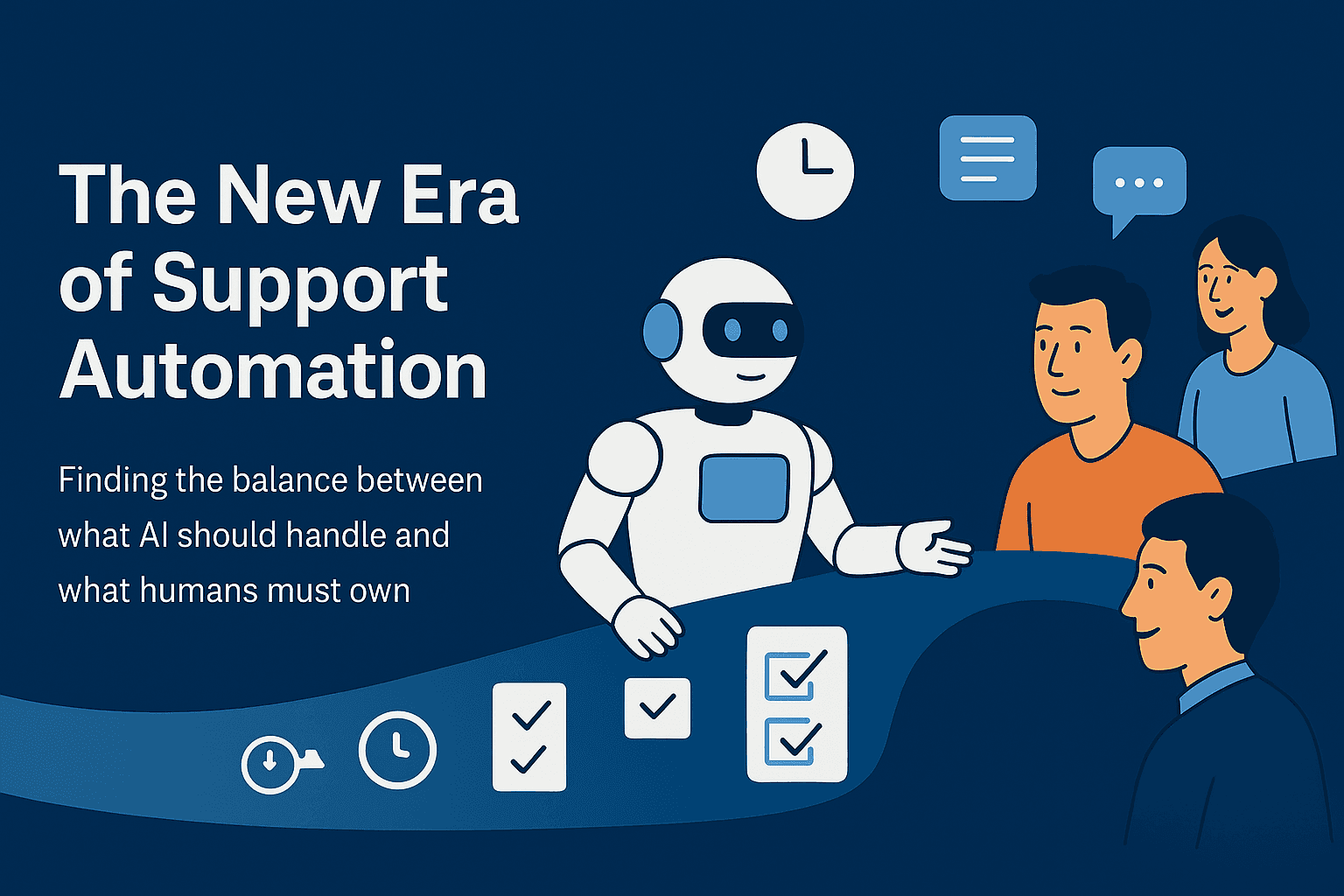
The New Era of Support Automation
AI has reshaped nearly every corner of customer experience. Support teams, who were previously burnt out by ticket volume, repetitive questions, and rising customer expectations, can now look to automation for faster and more consistent service. But as AI becomes more capable, a new challenge emerges: deciding what to automate and what must remain human.
Support automation is not a binary choice; it’s a spectrum. Go too far and you risk frustrating customers with robotic interactions. Automate too little and your team wastes time on work AI can handle instantly. The goal is to find the sweet spot, where customers feel supported, not processed.
This blog walks through exactly what tasks are perfect for automation, what should stay in human hands, and how to design a blended model that delivers the best of both worlds.
Why Automation Matters, But Not Everywhere
Customer expectations have changed. People want speed, availability, and accuracy, at any given moment. Although existing support teams can handle this, manual solutions are not scalable.
Support AI helps this through:
Reducing response times from minutes to seconds
Eliminating repetitive manual work
Creating more consistent answers
Allowing service reps to focus on meaningful, complex issues
Scaling support without needing to scale headcount
On the other hand, AI can misunderstand context, apply rules too rigidly, or answer completely incorrectly with absolute confidence. Worse, poorly designed automation can create a friction for customers: ending up in an endless loop of questions, escalations that never arrive, or sensitive issues being completely mishandled.
That’s why the “automate everything” approach fails. Not everything should be automated and the companies that get support right know exactly where AI adds value and where it doesn’t.
What Could Be Automated
Repetitive, High-Volume Questions | Examples:
|
Data Lookups Across Systems | Examples:
|
Structured Troubleshooting | Examples:
|
Workflow Initiation and Pre-Qualification | Examples:
|
Triaging Tickets to the Right Team | Examples:
|
What Shouldn’t Be Automated
Irreversible Decisions | Examples:
|
Emotionally Sensitive Conversations | Examples:
|
Ambiguous Problems | Examples:
|
When Exceptions are Needed | Examples:
|
Blending Humans and AI for the Best Support Experience
The best support teams don’t choose between humans and AI, they design a system where each does what it does best. AI handles the predictable, whilst humans handle the personal.
A balanced support model typically looks like this:
AI at the front gate for triage, FAQs, lookups, and workflows
Humans as the escalation layer for nuance, judgment, and relationship-building
AI as an internal assistant for drafting, summarizing, routing, tagging, and context gathering
Humans review insights to close support gaps by reviewing patterns, identifying gaps in knowledge or workflows, and refining documentation and processes so the overall system gets smarter over time.
The result? Faster and consistent support, more empathetic resolutions, and happier agents who spend their time on meaningful work, not robotic tasks.
The Best of Both Worlds
If you’re looking to start or improve your support automation, choosing the right AI agent could be the difference between 20% or 60% automation. You need a system that understands your workflows, handles real complexity and gives your team the clarity they need to improve.
Champ AI ensures you’re never left guessing on building or maintaining your automations. Our agents go beyond simple responses, they execute real written SOPs end-to-end, identify and escalate edge cases, and adapt to the unique parts of your business that other tools can’t touch.
Interested to see how we can help scale your support business? From insights to complex integrations, we’d be happy to walk through different use cases!