


Why Browser Automations Fail in Production, and How Champ Keeps Them Running
Production browser automation needs more than a successful agent demo. Learn how deterministic execution, AI recovery, authentication, and profile pools keep real workflows running.

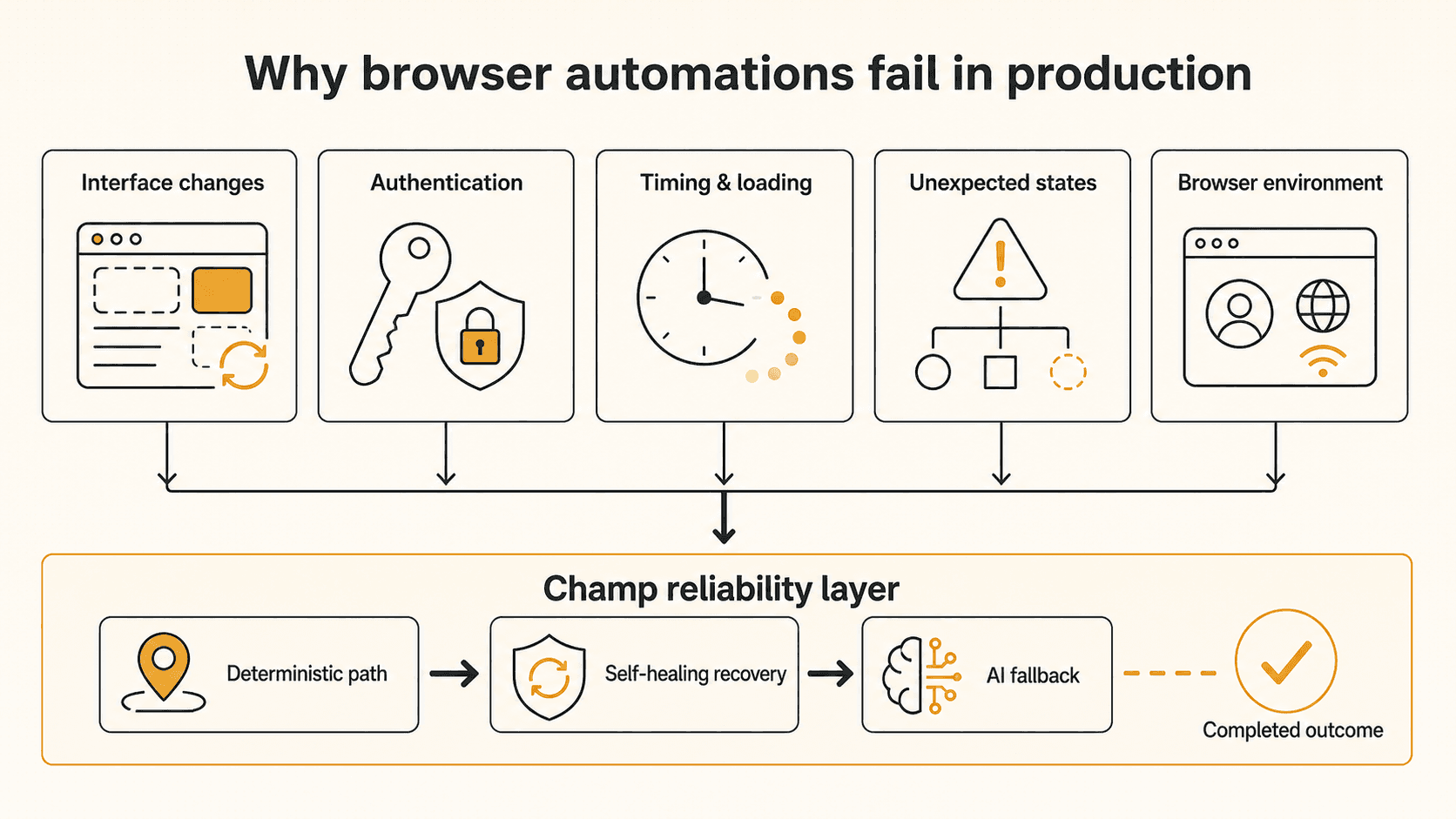
A browser automation can look perfect in a demo and still fail in production. The demo runs once, with a fresh login, a known input, and someone watching. Production runs every day against systems another company controls. Sessions expire, layouts change, accounts get challenged, and edge cases arrive without warning.
The difference between a prototype and a production automation is not whether an agent can click the right button once. It is whether the complete business process keeps moving when the expected path stops working.
Champ is designed around that operating reality. Stable work runs deterministically. AI takes over when the deterministic path needs help. Authentication and browser identities are managed as production infrastructure. Champ owns the workflow and the maintenance loop with the customer.
Why browser automations break in production
The browser is an unstable integration surface. A portal can insert a banner, rename a control, change a table, slow down a response, redirect to a login, or present a different MFA challenge. None of those changes need to be dramatic for a workflow to stop.
Pure scripts are predictable, but they cannot interpret every changed state. Pure AI agents are flexible, but asking a model to reason through every click introduces unnecessary latency, cost, and variability. Production reliability requires a deliberate combination of both.
- Unexpected page and workflow changes
- Dynamic load times, modals, and intermediate states
- Expired sessions and password rotation
- Email, SMS, and authenticator MFA challenges
- Account limits, lockouts, and unhealthy browser identities
- Business exceptions that require validation or human judgment
Start with deterministic execution
Known steps should be deterministic. A recorded or scripted action is fast, inexpensive, testable, and easy to audit. The same input follows the same validated path, and the runtime can prove whether each step achieved its intended result.
Champ uses deterministic execution as the production backbone. Model reasoning is not the default for every action. It is the recovery layer for the moments when the tested path no longer matches reality.
Recover with AI inside the same live session
When a deterministic step fails validation, Champ can hand control to an LLM-driven browser agent inside the same live session. The agent receives the goal, current page state, and relevant workflow context, then attempts the intended step.
Same-session recovery matters. Restarting can discard login state, uploaded files, open tabs, navigation context, and work already completed. Champ preserves that progress, records the recovery, and returns control to the durable workflow when the step succeeds.
A recovery should not remain an improvisation forever. Champ uses the evidence from production runs to improve the versioned workflow so repeated known cases become more deterministic over time.
Treat authentication as part of the runtime
A successful login during implementation does not prove a workflow can run for months. Production automation has to recognize an authentication wall, retrieve approved credentials, complete permitted MFA flows, and return to the interrupted step without exposing secrets.
Champ supports persistent browser profiles, automatic re-authentication, email and SMS OTP handling, and 1Password access for usernames, passwords, and TOTP codes. Credentials remain in the approved vault instead of being copied into workflow definitions or logs.
Use profile pools so one identity cannot stop the queue
Some portals limit concurrent sessions, rate-limit accounts, or lock an identity after repeated challenges. A workflow tied to one profile turns a single account problem into a full operational outage.
Champ profile pools select a healthy approved identity for each run. If one profile cannot authenticate, the runtime can mark it unhealthy, move to another profile, and let the first enter a repair path. Pooling is operated within the customer's access policies and the target portal's requirements.
What self-healing should actually mean
Self-healing is often used to describe a fuzzy selector or an agent retry. Those are useful, but a production definition should cover the entire outcome. The system should detect the deviation, recover the live run, preserve authentication, use alternate capacity when needed, and make the durable workflow stronger.
- Resilient targeting absorbs small interface changes
- Same-session AI recovery handles changed or ambiguous states
- Authentication repair restores expired access safely
- Profile fallback protects queue capacity
- Versioned improvements prevent the same exception from repeating
- Human escalation handles cases automation should not decide alone
Measure the business outcome, not bot uptime
A workflow can report healthy infrastructure while still missing cases or producing the wrong result. The primary metric should be end-to-end successful completion for a named workflow, input cohort, and time window.
- End-to-end completion and correctness
- Deterministic step success rate
- Fallback invocation and AI recovery rate
- Authentication and profile fallback success
- Human intervention rate
- Repeat exceptions that should become durable fixes
- Time to detect, recover, and improve
Reliable browser automation is not one clever agent. It is a managed system that combines predictable execution, adaptive recovery, production identity operations, evidence, and a team accountable for the workflow.
Champ builds and operates that complete system. Customers bring us the process, portals, inputs, exceptions, and desired result. We own the automation loop that keeps it running.
Bring Champ a workflow
Show us the systems, inputs, exceptions, and completed result your team owns today. Champ will map how to build and operate it as a managed automation.
Continue reading
See all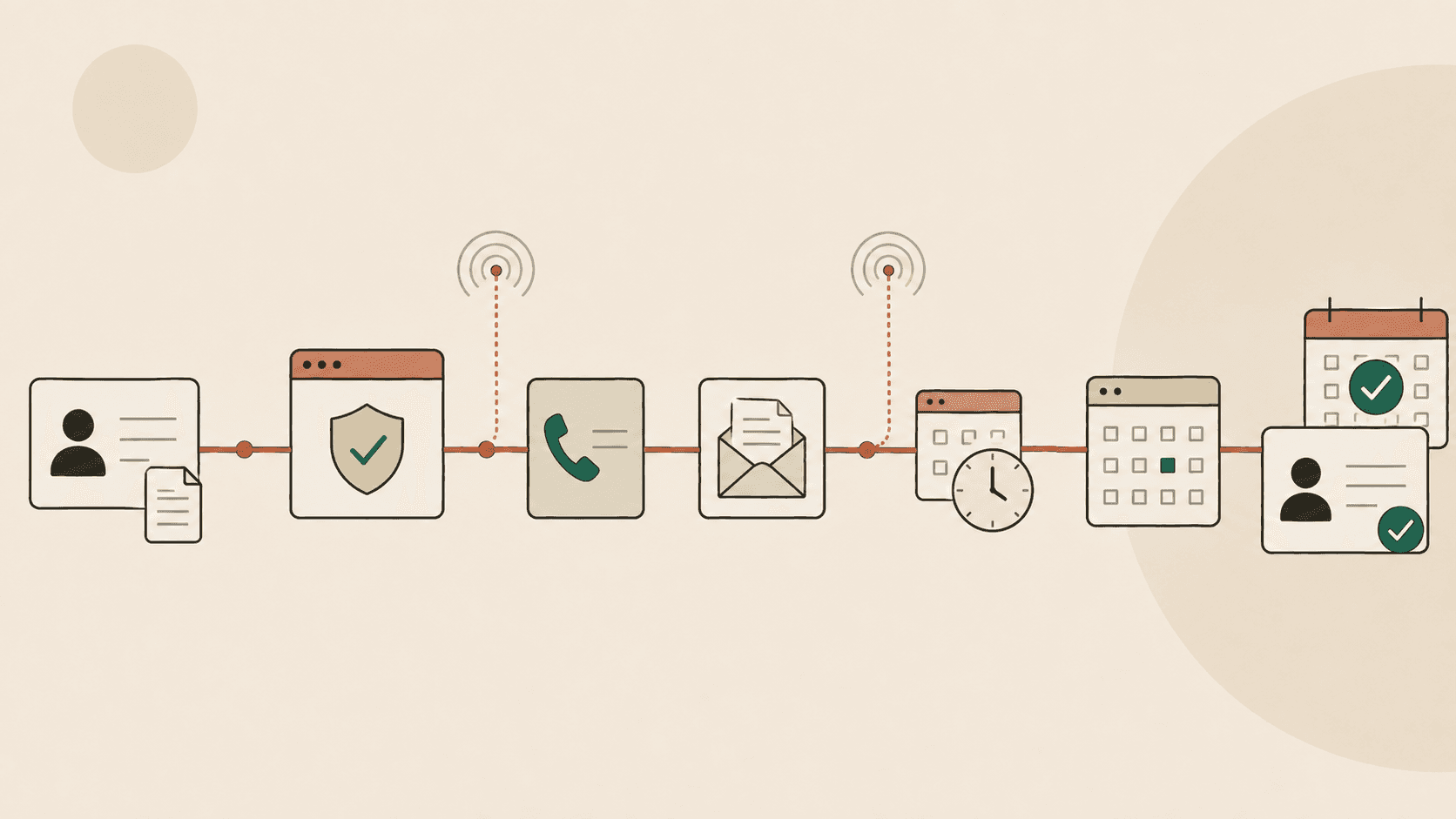
The World Doesn't Need Another Point Solution
Most software automates one step and leaves people to manage the gaps. Champ keeps one case open across workflows, channels, and systems until the work is finished.
The Hidden Tax on Provider Growth
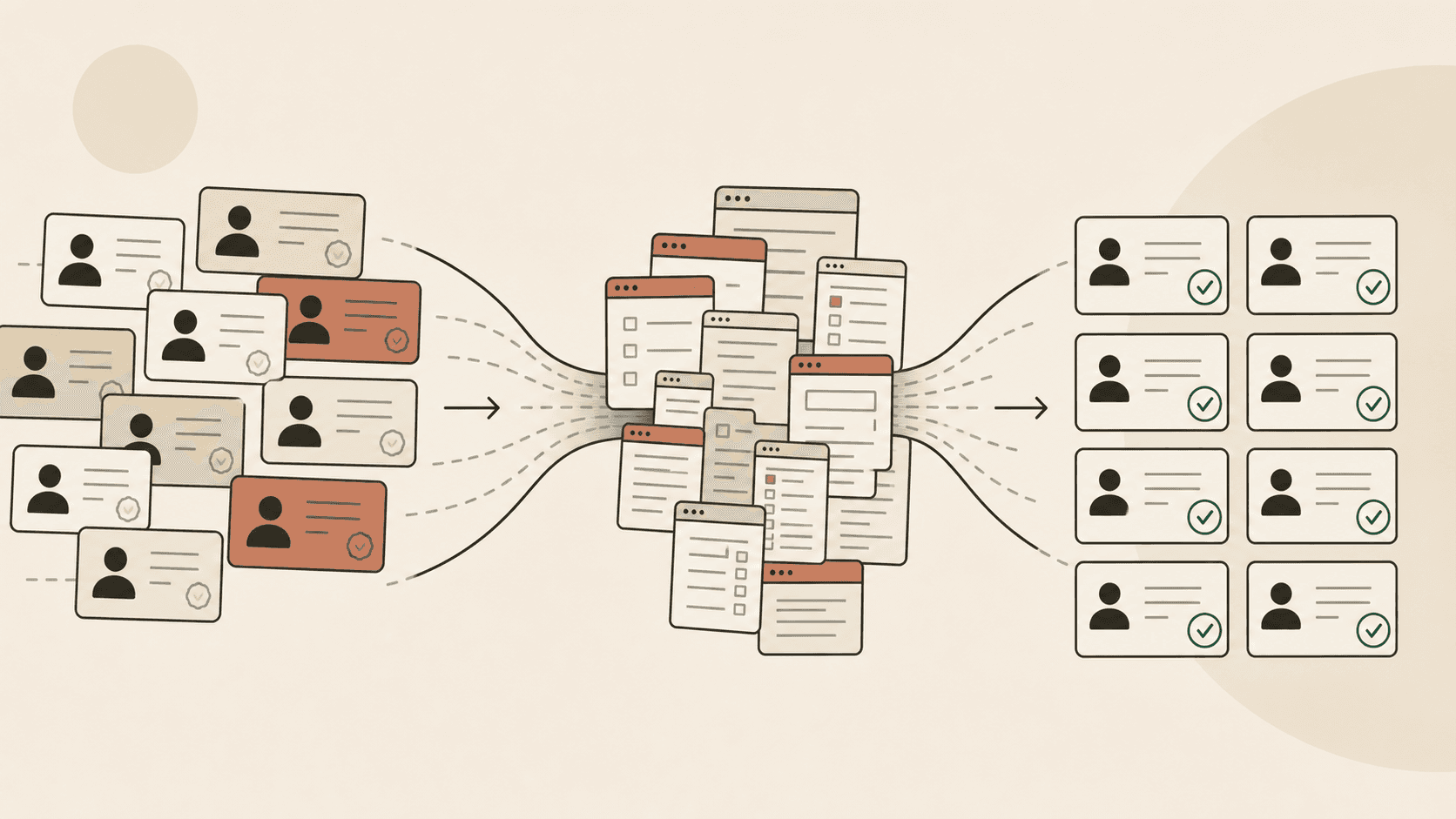
Digital-health networks can recruit providers faster than they can make them billable. The gap between a signed contract and payer activation is the hidden tax on provider growth.
The Healthcare Ops Bottleneck AI Is Finally Ready to Solve
Healthcare’s hardest workflows live between portals, PDFs, phone calls, and internal systems. Here is how Champ automates the work between them.